peptides
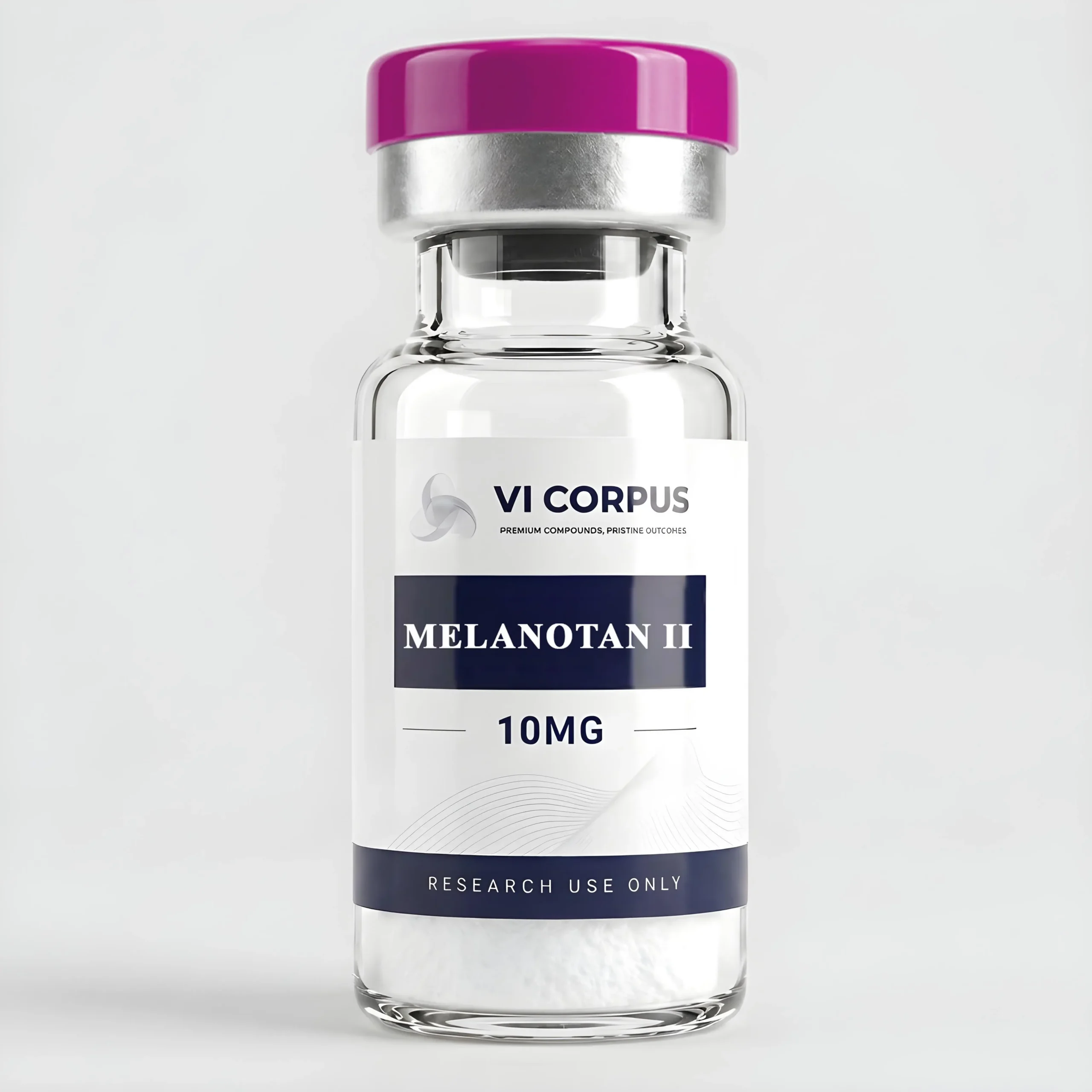
MELANOTAN II
41 sold this week
Select a bundle above to unlock your discount
About this product
Melanotan II — Peptide Overview
Melanotan II is a synthetic peptide composed of seven amino acid residues. It belongs to the cyclic heptapeptide classification, which describes both its seven-residue composition and the internal ring within its structure.
Also written as Melanotan-II, Melanotan 2 or MT-II, the compound can be identified through its peptide sequence, molecular formula and CAS registry number. These identifiers distinguish it from other peptides with similar names, including Melanotan I.
Structure and Composition
Melanotan II contains an internal lactam ring formed between the side chains of its aspartic acid and lysine residues. These occupy positions 2 and 7 in the peptide sequence.
Its structure also includes norleucine, a non-standard amino acid, and D-phenylalanine, whose D designation specifies its stereochemical configuration. The amino terminus is acetylated, while the carboxyl terminus is amidated.
These features are recorded in the sequence notation Ac-Nle-Asp-His-D-Phe-Arg-Trp-Lys-NH₂, with a 2–7 lactam linkage. The ring linkage and terminal modifications are essential parts of the compound’s identity.
Melanotan II Compound Information
| Property | Details |
| Compound name | Melanotan II |
| Alternative names | Melanotan-II; Melanotan 2; MT-II |
| Classification | Synthetic cyclic heptapeptide |
| Amino acid count | 7 residues |
| Peptide sequence | Ac-Nle-Asp-His-D-Phe-Arg-Trp-Lys-NH₂ |
| Ring linkage | Lactam bond between residues 2 and 7 |
| CAS number — parent compound | 121062-08-6 |
| N-terminal feature | Acetylated amino group |
| C-terminal feature | Amidated terminus |
| Molecular formula — parent compound | C₅₀H₆₉N₁₅O₉ |
| Molecular weight — parent compound | Approximately 1024.2 g/mol |
Understanding Compound Specifications
Melanotan II and Melanotan I are distinct compounds. Their names should not be used interchangeably, and each requires its own chemical identifiers and structural specifications.
For Melanotan II, the amino acid sequence alone does not describe the complete molecule. The internal ring, residue configurations and terminal groups must also be considered when comparing chemical records.
The molecular formula and molecular weight above describe the parent compound. An acetate or other salt form has additional components that should be identified separately in its specifications.
Compound identity and batch quality are separate pieces of information. Structural identifiers describe the molecule, while batch-specific analytical records document the characteristics measured in an individual sample.