erectile-performance
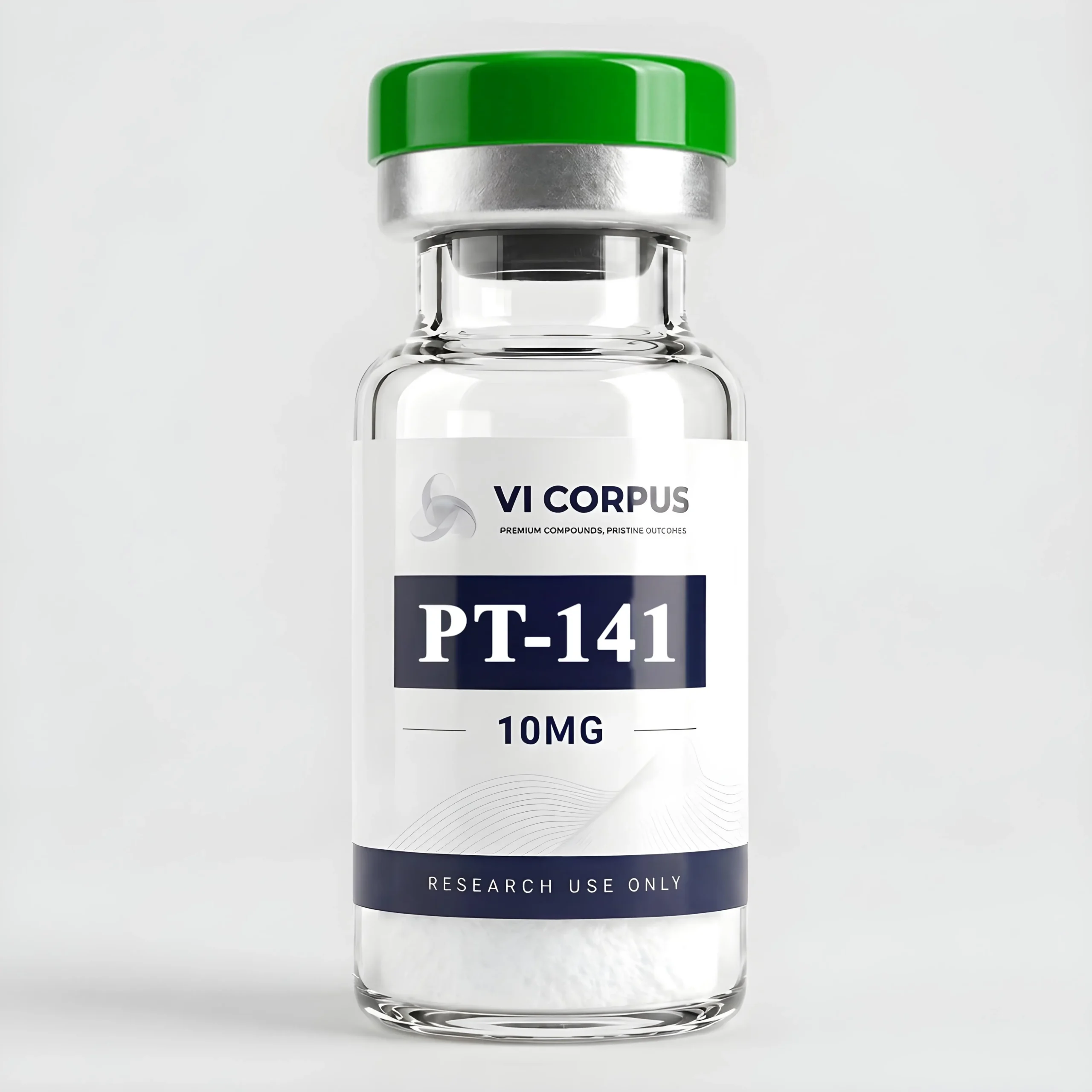
PT-141
30 sold this week
Select a bundle above to unlock your discount
About this product
PT-141 — Peptide Overview
PT-141, also known as bremelanotide, is a synthetic peptide composed of seven amino acid residues. It belongs to the cyclic heptapeptide classification: “hepta” refers to seven residues, while “cyclic” describes the ring formed within its peptide structure.
The names PT-141 and bremelanotide identify the same parent compound. Its chemical identity can be described through its molecular structure, terminal groups, molecular formula and CAS registry number.
Structure and Composition
PT-141 contains an internal ring created by a bond between amino acid side chains. This arrangement distinguishes it from linear peptides, which do not contain this internal peptide ring.
The molecule also has an acetylated amino terminus and a free carboxylic acid at its carboxyl terminus. These terminal features form part of its chemical structure and are included in the parent compound’s molecular formula and molecular weight.
Peptide length, ring formation and terminal chemistry are all relevant to identification. Together, they provide a more precise description of bremelanotide than the general term “synthetic peptide.”
PT-141 Compound Information
| Property | Details |
| Compound name | PT-141 |
| Alternative name | Bremelanotide |
| Classification | Synthetic cyclic heptapeptide |
| Amino acid count | 7 residues |
| CAS number — parent compound | 189691-06-3 |
| Structural feature | Internal peptide ring |
| N-terminal feature | Acetylated amino group |
| C-terminal feature | Free carboxylic acid |
| Molecular formula — parent compound | C₅₀H₆₈N₁₄O₁₀ |
| Molecular weight — parent compound | Approximately 1025.2 g/mol |
Understanding Compound Specifications
PT-141 and bremelanotide are alternative names for the same peptide, while bremelanotide acetate identifies a salt form. The distinction matters when comparing chemical records, molecular formulas and product specifications.
The formula and molecular weight above describe the parent compound without additional acetate components. Documentation for an acetate preparation should identify the salt form separately rather than treating its complete composition as identical to the parent peptide.
Compound identity and batch quality are separate pieces of information. Structural identifiers describe the molecule, while batch-specific analytical records document the characteristics measured in an individual sample.
Studies and Additional Info